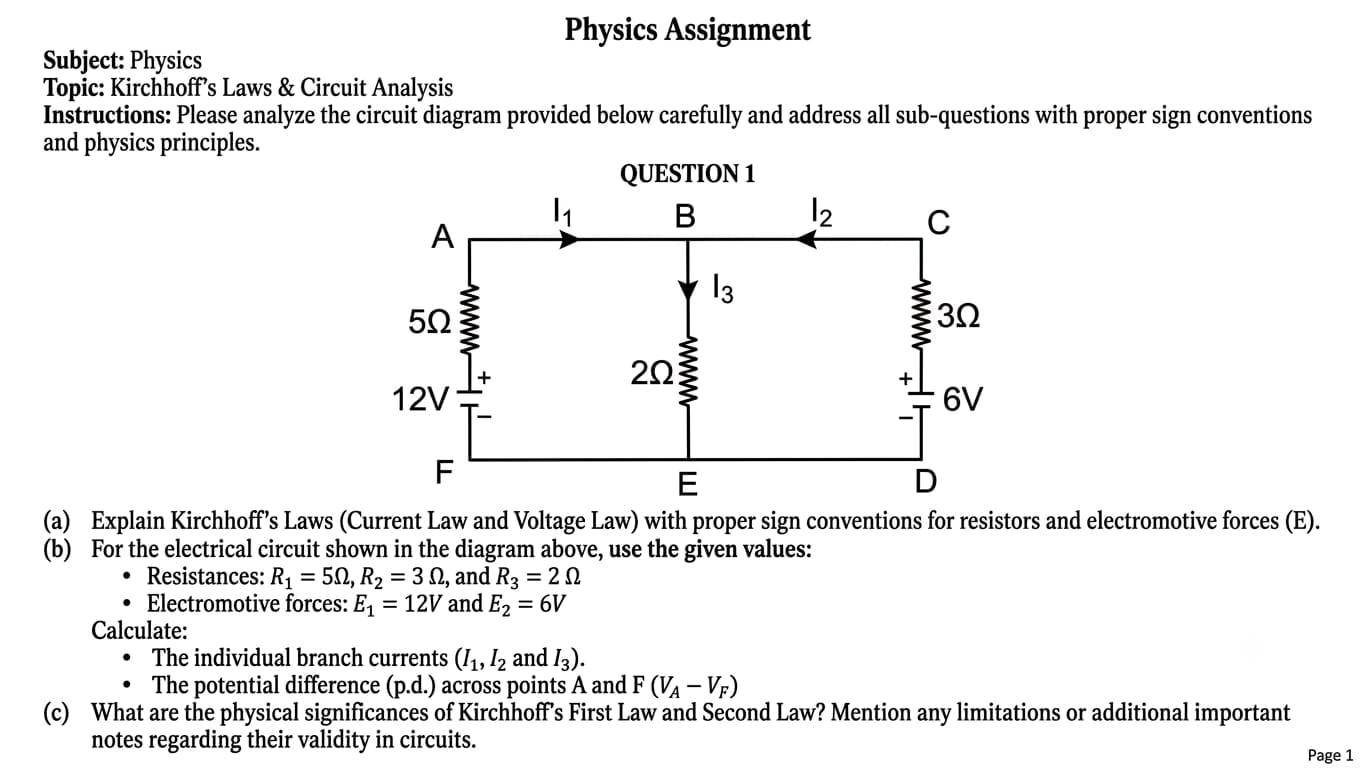
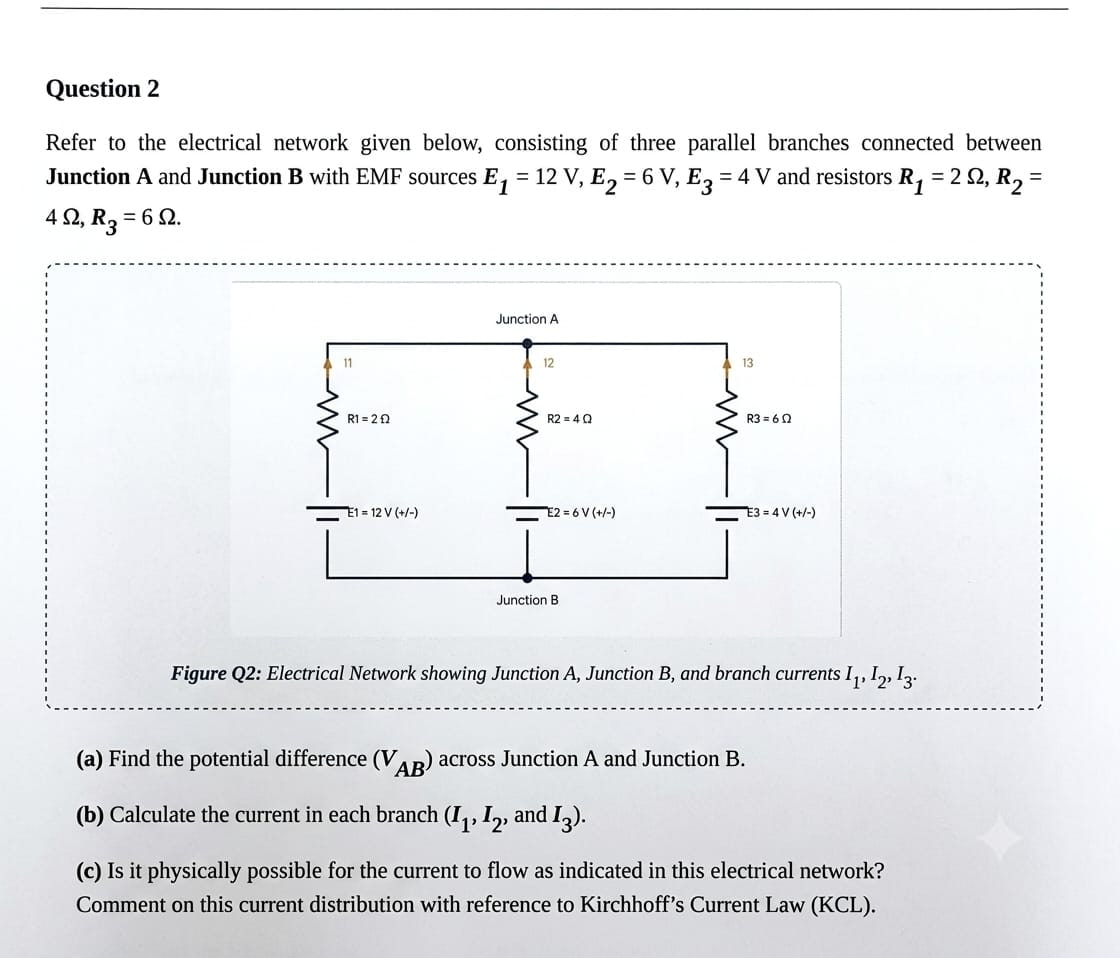
Kirchhoff's laws:
Kirchhoff's Laws are fundamental principles in physics and engineering formulated by German physicist Gustav Kirchhoff. They primarily describe how electrical current and voltage behave in a circuit
Why are Kirchhoff's laws important for electrical circuits?
Kirchhoff's laws are foundational to electrical engineering because standard Ohm's law (V=IR) cannot solve complex circuits on its own. To solve Kirchhoff's laws problems, an understanding of sign conventions is important.
Sign conventions for resistors :
-IR : Travel in current direction,drop in potential & +IR : Travel opposite to current, rise in potential.
Sign conventions for emfs
Potentiaal drops = -E, travel direction from +to - and, Potential rises =+E travel direction from -to +
Kirchhoff's Laws are sometimes also referred to as Kirchhoff's Rules. While the scientific community officially calls them 'Laws' because they are based on universal conservation principles, many textbooks use the term 'Rules' to describe them as practical tools for solving circuit numericals.
KIRCHHOFF'S RULES are the following two statements.
**Kirchhoff's junction rule: The algebraic sum of the currents into any junction is zero. i.e £ I =0 (KCL )
**Kirchhoff's loop rule: The algebraic sum of potential differences in any loop, including those associated with emfs and those of resistive elements, must equal zero. i.e £ V =0 (KVL )
These two rules are
*Kirchhoff's Current law (KCL ) based on conservation of charge . * **Kirchhoff's Voltage law (KVL ) based on conservation of energy.
Note: please read the contents carefully, then try to solve the assignment and answer the associated reasoning questions. Your opinion on this is highly appreciated.
Files
Attachments