Tension in String and Effective Acceleration for Submerged Objects
Problems and step-by-step solutions for finding string tension for submerged objects of different relative densities under various upward acceleration conditions.
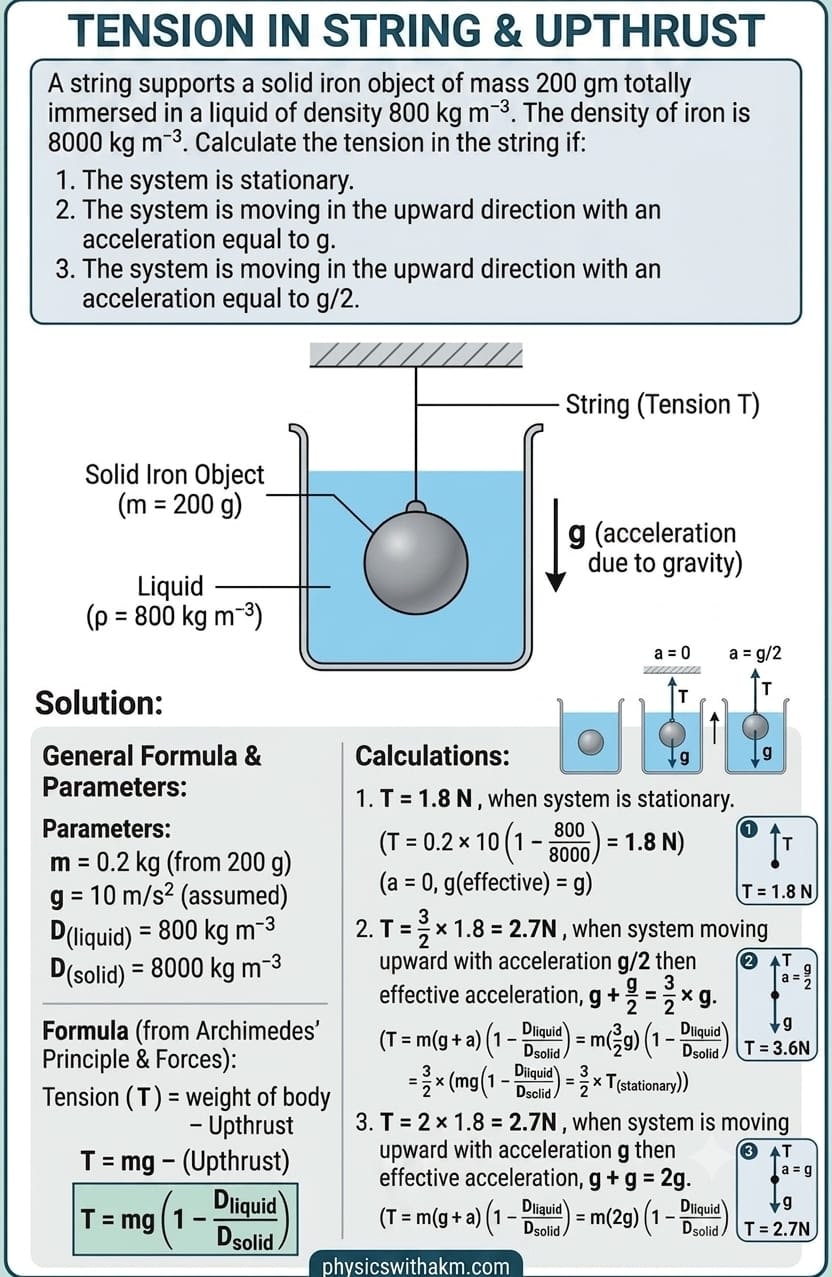
Problem 1: Solid Iron Object Suspended in Liquid (Denser than Liquid) Question: A string supports a solid iron object of mass 200 gm totally immersed in a liquid of density 800 kg/m³. The density of iron is 8000 kg/m³. Calculate the tension in the string if (Take g = 10 m/s²):
a) The system is stationary.
b) The system is moving in the upward direction with an acceleration equal to g.
c) The system is moving in the upward direction with an acceleration equal to g/2.
Solution for Problem 1:Given Data:• Mass of iron (m) = 200 g = 0.2 kg• Density of iron (ρ iron) = 8000 kg/m³• Density of liquid (ρ liq) = 800 kg/m³• Volume of object (V) = m / ρ ironGeneral Formula Derivation:Since the object tends to sink (ρ_iron > ρ_liq), the string supports it from above:
a ). System is Stationary: g_eff = g = 10 m/s² ⇒ T₁ = 0.18 × 10 = 1.80 N
b ). Moving upward with acceleration a = g: g_eff = g + a = 2g = 20 m/s² ⇒ T₂ = 0.18 × 20 = 3.60 N
c ). Moving upward with acceleration a = g/2: g_eff = g + a = 1.5g = 15 m/s² ⇒ T₃ = 0.18 × 15 = 2.70 N
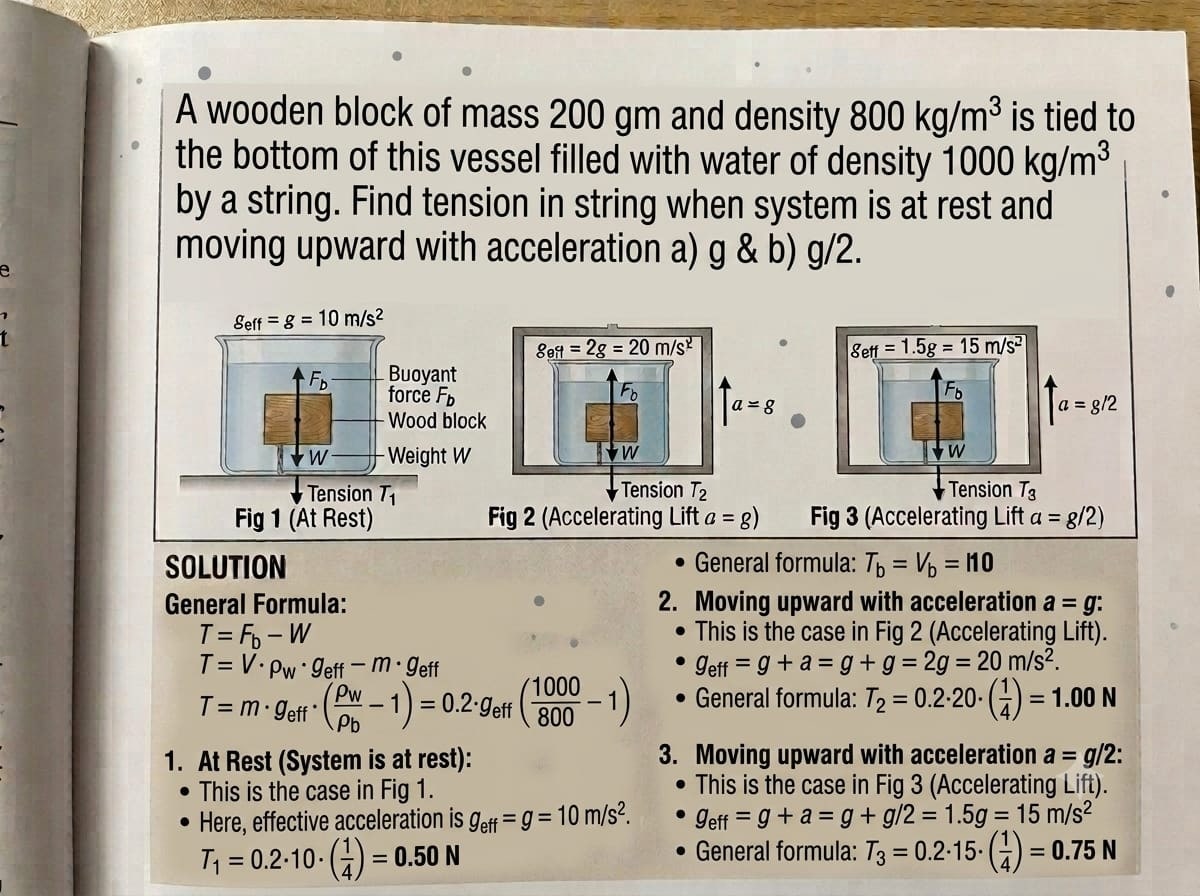
Problem 2: Wooden Block Tied to Bottom of Vessel (Lighter than Liquid) Question: A wooden block of mass 200 gm and density 800 kg/m³ is tied to the bottom of this vessel filled with water of density 1000 kg/m³ by a string. Find tension in string when system is (Take g = 10 m/s²):
a) At rest.
Moving upward with acceleration b) g & c) g/2.
Solution for Problem 2:Given Data:• Mass of wood (m) = 200 g = 0.2 kg• Density of wood (ρ b) = 800 kg/m³• Density of water (ρ w) = 1000 kg/m³• Volume of block (V) = m / ρbGeneral Formula Derivation:Since wood tends to float (ρ_w > ρ_b), the string pulls it downward:
a ) System is at Rest: g_eff = g = 10 m/s² ⇒ T₁ = 0.2 × 10 × (1/4) = 0.50 N
b ). Moving upward with acceleration a = g: g_eff = g + a = 2g = 20 m/s² ⇒ T₂ = 0.2 × 20 × (1/4) = 1.00 N
c). Moving upward with acceleration a = g/2: g_eff = g + a = 1.5g = 15 m/s² ⇒ T₃ = 0.2 × 15 × (1/4) = 0.75 N
Files
Attachments